
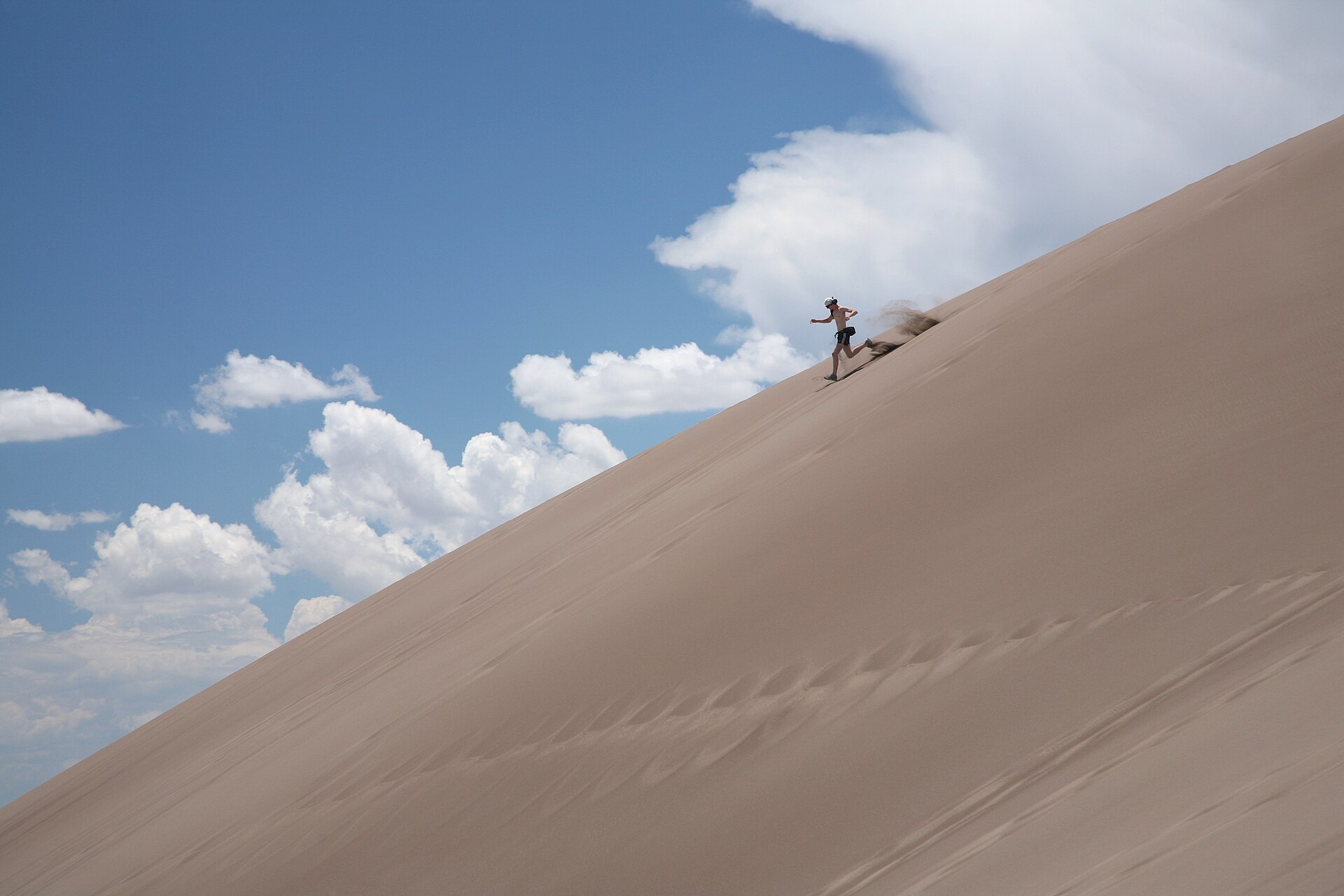

A visitor runs down a steep slope, sending a small stream of sand behind their feet. The photograph looks like a scene of movement and sunshine. At Colorado’s Great Sand Dunes, moving sand can sometimes add something a picture cannot capture: a deep humming sound.
The phenomenon is often called singing sand. You can hear an actual park recording through the National Park Service link below, then look again at what seems like an ordinary sandy slope.
1. The sound is real, and there is a recording
The National Park Service includes singing sands in its natural sound library. Its entry links to a recording made at Great Sand Dunes National Park and Preserve, describing a rare humming or booming sound.
The useful starting point is your own ears. Open the park’s sound-library entry and follow its recording link. The photographs here show the location and moving sand; they are separate from that recorded event.
2. An avalanche of sand can start it
The park explains that the humming accompanies tumbling sand during an avalanche. Storms can produce natural avalanches, and people moving sand down a dune face can also trigger the phenomenon.
That gives the scene in the main photograph a new possibility, without telling us whether that particular descent made a sound. A slope that looks still in one moment can become a moving layer of grains in the next. The park’s geology guide includes its explanation and recording.
3. Researchers have taken the booming seriously
A 2007 study by Nathalie Vriend and colleagues reported field measurements of booming dunes. It described a dominant audible frequency of 70 to 105 hertz, along with higher harmonics.
The team proposed that the dune can act as a natural waveguide, with the depth of a loose, dry surface layer helping determine the sound’s frequency. Those findings concern the dunes measured in that study; they are not a frequency measurement of the photographs on this page. Read the research abstract.